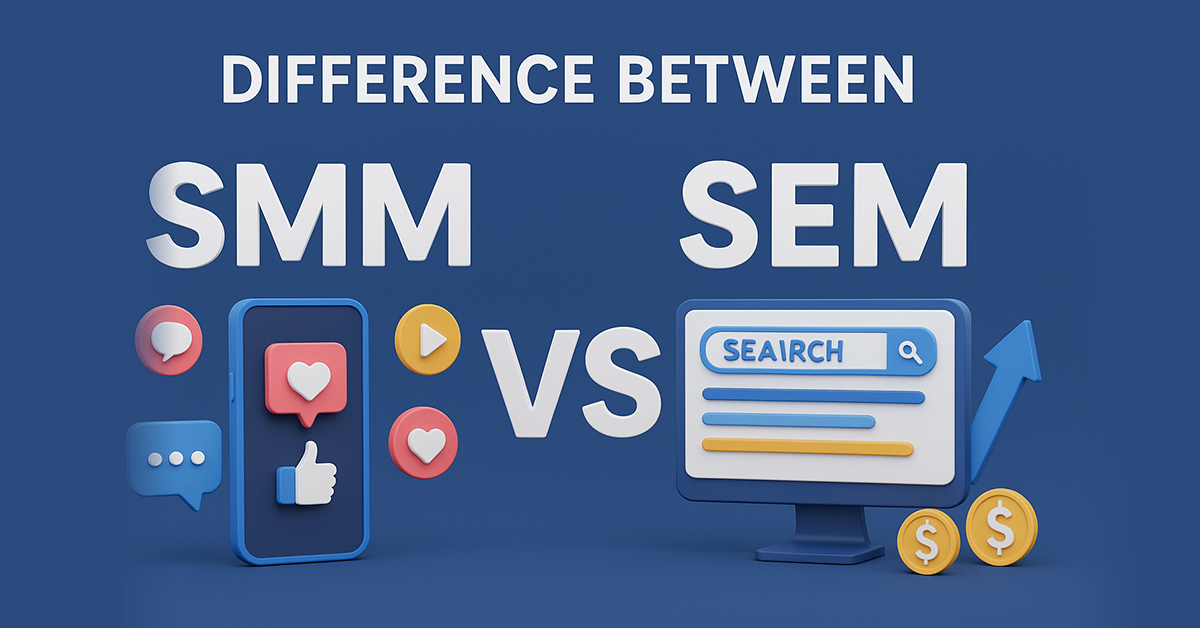
Difference Between SMM and SEM: Choose the Right Strategy
In digital marketing, many people get confused in their attempts to establish the difference between SMM and SEM. The two assist in the expansion of a business, yet they operate in highly different ways. Social media promotion, the things you see as you scroll Instagram, Facebook, or TikTok are all about SMM. SEM is concerned with search engine presence, the advertisements that you get when you type something in Google.
Both channels are potent, with more than 5 billion people on social media and billions of searches running daily on Google. However, the audience's mental state, objectives, and outcomes are not identical. Social media builds attention and engagement, while search engines connect you with people who already want something.
This blog will explain everything in simple words so you can clearly understand the real difference between SMM and SEM, how each works, and which one is right for your brand.
What Is SEM?
Search Engine Marketing, or SEM, is a paid method of being on the first page of Google when an individual searches for something. SEM presents your site immediately without waiting to get organic traffic, it does so using PPC advertising and Google Ads, among other paid search programs.
It serves individuals with a definite intent to search, i.e., individuals are already seeking a product, service, or solution. That is why SEM frequently leads to quicker results, better-quality traffic, and fast conversions.
As an example, in case a person enters the best SMM services or buys Instagram growth, SEM will make your ad the first one to be shown. This will provide immediate visibility, more clicks, and an enhanced possibility of winning customers ahead of your competitors.
Before knowing about the difference between SMM and SEM, it is important to comprehend the concept of SEM since it targets search engines, not social platforms, and targets users who are willing to act at the moment.
The Advantages of SEM You Need to Know
SEM has been developed as one of the most effective digital marketing tools since it assists businesses to reach customers at the most ideal time when customers are in the act of searching. It provides immediate exposure, speedy performance, and very narrow-focused traffic as opposed to waiting months before organic growth takes place. SEM has the potential to enable any brand to compete even with larger companies using the right strategy.
1. Instant Visibility on Google
SEM places your website at the first spot on the list of search results the moment it receives your advertisement. You do not have to wait until you get ranked under search engine optimisation. This ensures that SEM is ideal for new businesses or businesses wishing to have a quick exposure. It assists you in making your presence felt before the rivals and impressing them at first sight.
2. Highly Targeted Traffic
In SEM, you can reach people through the use of keywords, place, age, devices, and even search history. This makes sure that you get individuals who are interested in your product or service. The closer to the target you are, the better your chances of good clicks and conversions, and each ad dollar will be worth more.
3. Fast and Measurable Results
SEM provides clicks, conversions and performance in real-time. It takes only hours to know what works and what does not. That is why it is easy to tweak your ads, optimise your budget, and enhance ROI within a short time. It can be measured in all aspects, and hence you are not lost on where your money is spent.
4. Ideal with High-Intent Customers.
Individuals visiting Google search already have an intention to purchase, study and/or make comparisons. This implies that SEM will access customers who are willing to make a move. They are already on the right track of knowing what they desire, and so your chances of getting leads or sales are higher. SEM assists companies in reaching out to interested buyers at the appropriate moment.
5. Helps You Beat Competitors Quickly
Although your rivals are ahead in organic ranking, SEM will enable you to be above the rest using paid advertisements. This puts you at an immediate benefit and assists you in capturing traffic that they can lose.
What Is SMM?
The SMM or Social Media Marketing users can choose a service brand or a product on such platforms as Facebook, Instagram, TikTok, and Twitter. Social Media Marketing, unlike SEM, aims at developing relations, engagement, and brand awareness, and only when people are willing to purchase the product. It assists businesses in reaching out to the audiences they spend the majority of their time with online.
SMM involves content posting, advertising, interaction with followers, and using influencers. The aim is to establish a formidable online presence that is appealing, builds trust, and fosters communication. Contrary to paid advertisements, the social media campaign can keep on increasing intuitively with likes, shares, and comments.
It is also possible to use platforms such as Instagram and TikTok to track reach, engagement, and growth payments of analytics. Social media marketing is the best approach when the brand would like to create a loyal fan base, as well as remain at the forefront of the minds of prospective clients. To have a clear explanation of the contrast between SMM and SEM, it is important to know what SMM is about, since it is about engagement and visibility, and does not involve immediate search-based outcomes.
The Advantages of SMM You Need to Know
Social media marketing is an effective business tool since it aids in establishing a high presence online as well as long-term customer relationships. It is more about engaging, brand awareness, and trust and not only immediate sales. Social media is used by billions of users across the globe, and SMM will enable the business to access a considerable number of people. Realising the benefits assists brands with better planning marketing tactics.
1. Increases Brand Awareness
Through social media, your brand will be able to reach thousands of users in a day. Posting and sharing regularly will make people more familiar with your brand. In the long run, this will create credibility and remembrance of your business. Heavy social presence keeps your brand in the minds of your audience.
2. Boosts Customer Engagement
SMM promotes likes, sharing and comments and engagements with your brand. Interesting content will assist in initiating dialogues and building customer relationships. Engagement is also high, and this enhances brand loyalty and makes your audience remain interested. This association normally results in improved long-term outcomes.
3. Cost-Effective Marketing
Social media marketing can be significantly cheaper than other methods of advertising or SEM. Low-budget campaigns can be used to reach thousands of users. Paid advertisements are not necessary even to attract attention to organic content. This renders SMM the best in small and medium businesses.
4. Builds a Loyal Community
Through consistent interaction, storytelling, and responding to followers, SMM helps create a loyal audience. Loyal followers are more likely to purchase, recommend your brand, and share your content. This community strengthens your brand’s reputation and reach over time.
5. Provides Measurable Insights
Engagement, reach, clicks, and conversions analytics are provided by social media. Brands are able to monitor successful content and modify strategies based on it. This assists in enhancing ROI and streamlining campaigns.
Also Explore: Top Benefits of Using an SMM Panel for Fast Online Growth
How SMM and SEM Work Together
Most of the businesses believe that they must choose either SMM or SEM, but when combined, the power becomes real. Whereas SEM targets individuals who are actively seeking products or services, SSM creates awareness and contact among the audience that already does not know your brand. The mixture of the two will make sure that you will reach the people at each stage of their journey.
Increases Visibility: SEM will allow you to be on the first page of the search engine, whereas SMM will allow you to always present your brand on social media. Collectively, they make sure that your business is visible whenever people are searching and also when they are browsing social media. This two-fold nature spreads the brand awareness within a short time.
Supports Lead Nurturing: SMM facilitates that users can be educated and engaged with posts, stories, and videos. SEM attracts those users with high intent to convert. A combination of both enables companies to take potential customers on the path to action in an effective manner.
Optimises ROI: With the integration of SEM and SMM, companies are able to spend their funds in a sensible manner. SEM will deliver instant traffic, whereas SMM will buttress long-term interaction. The combination of the two is more efficient in terms of maximising the outcome of each marketing dollar and increasing the long-term growth.
Improves Data Insights: Simultaneously using SEM and SMM will present more detailed data concerning your audience. You are able to see what people are searching, how they socialise on social media, and what contents bring in engagements. This is a combined understanding that can be used to augment campaigns in the two channels.
Establishes a Powerful Brand Presence: Brands with an SMM presence are seen everywhere their customers search the online results and social feeds. Such ubiquitousness generates trust, elevates recognition and enhances the likelihood of transforming users into loyal customers.
The Core Difference Between SMM and SEM
It is easier to see the difference between SMM and SEM by comparing their objectives, approaches and outcomes. They are both different elements of digital marketing, yet they do so in entirely different ways. SEM is interested in paid search advertisements when targeting people who are in search of products or services. SMM is based on social platforms to interact and establish a relationship with the audience and raise brand awareness.
Purpose and Goal: The principal objective of SEM is to achieve instant traffic and conversions of intentional searching people. Social media marketing is meant to generate interest, recognition and prospective customer relationships that are not yet willing to purchase. One is action-oriented, whereas the other is relationship-oriented.
Platform and Reach: SEM operates on search engines such as Google and Bing as a paid search engine and PPC advertising. Social media platforms such as Instagram, Facebook, LinkedIn, and TikTok are the apps where SMM is used. SEM engages individuals who are actively searching, but SMM engages those who are browsing, scrolling or searching.
Cost and Budget: SEM traditionally involves a greater initial investment since you pay for each click or conversion. SMM is possible to begin at a smaller budget and expand organically via content, shares, and engagement. SEM produces quicker outcomes; SMM produces brand building in the long run.
Audience Type: SEM focuses on high-intent customers who are willing to act. SMM is used to reach a wider audience to educate and entertain, as well as to win the loyalty of the audience in the long term. SEM is concerned with the searchers; SMM with the social explorers.
Results Timeline: SEM will be able to provide instant visibility and conversions when campaigns are active. Social Media marketing typically requires weeks or months to achieve interactions, adherents and brand credibility. They are both as important, but their plans and strategies differ.
Common Mistakes People Make When Choosing Between SMM and SEM
The difference between using SMM and SEM is encountered by numerous businesses, and even minor mistakes could cost time, money, and outcomes. The knowledge of these mistakes can make you spend your budget and opportunities. These are the most popular errors that people commit in determining the strategy to adopt.
Confusing Awareness with Intent: Some brands believe that SEM and SMM are identical. SEM serves individuals who are willing to act, and SMM generates awareness and interest in the long run. The point of using one strategy instead of the other is that it may result in poor performance and a waste of time.
Ignoring Audience Behaviour: Underestimating the interaction of your audience is a major mistake of going online. Individuals on social media operate in a different way as compared to those using search engines. Failure to do so may lead to irrelevant advertisements or poor participation, thus rendering your campaigns ineffective.
Concentrating on Short-Term Performance: SEM provides rapid traffic, and the sole concentration on it does not consider long-run progress. Likewise, SMM develops the community gradually, and the desire to sell immediately may ruin everything. It is critical to have a balance between the two in a bid to achieve sustainable outcomes.
Failure to track and analytics: Most of the businesses do not track their campaigns adequately. It is impossible to know what is working without tracking clicks, engagement, or conversions. SEM and SMM offer quantifiable data, and not utilising them may be a waste of resources.
Ignoring Budget Allocation: ROI can be affected adversely by overspending on a specific channel without any strategy in place. SEM can also devour the budget in the absence of optimisation, whereas SMM can be cheap and slow to scale. It is important to smartly divide the two channels.
Failure to combine strategies: Some brands do not view SEM and SMM as complements but rather as competitors. Combining them is capable of enhancing reach, engagement, and conversions. Ignoring the combined potential is a missed opportunity for growth.
Also Explore: How to Choose a Telegram SMM Panel for Real Growth
Conclusion
Understanding the difference between SMM and SEM is critical to every business that desires to succeed on the internet. SEM provides quick and focused outputs in terms of reaching high-intent users, and SMO creates long-range results, awareness, and a faithful audience. Each of the strategies has its own benefits, and the most intelligent brands apply them both to gain the most visibility, traffic, and conversions.
The decision on the appropriate method will be based on goals, budget, and audience behaviour. The neglect of one approach or the frequent pitfalls may slow the growth and squander resources. SMM and SEM used together can help you to be sure that your brand appears to the right people at the right time.
At SMMReal, we enable companies to use social media marketing, as well as search engine marketing, to get quick outcomes and to have long-term growth. It may be the creation of an interest with SMM or the acquisition of high-intent traffic with SEM, with either, we make sure that your brand is not only visible but competitive and successful in the digital world.